Day 102: Rupa – Disco Jazz
I believe I have been struck down with whatever plague is currently making its way through Scotland. I really feel like my immune system has never recovered from lockdown and/or covid, I feel like I catch every cold that’s going around. Either that or I never used to pay as much mind to when I was ill. Anyway, I’m tired as all hell and in the market for a nice album to listen to while I wash my makeup brushes and sponges, because otherwise I probably won’t do it.
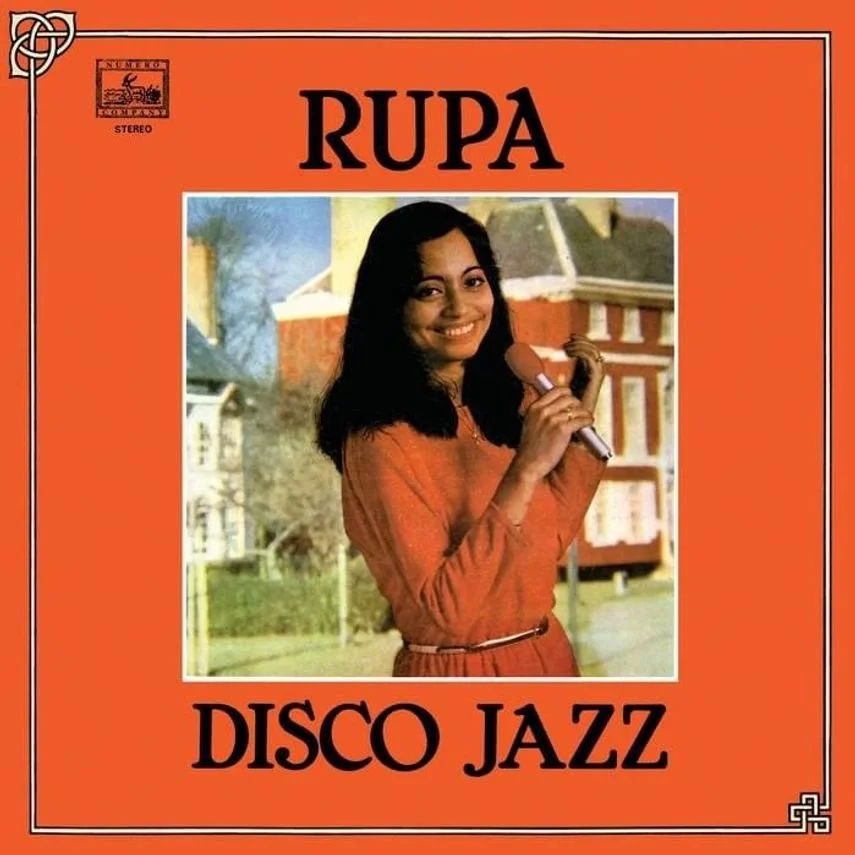
Album cover courtesy of Numero Group
I love a good story almost as much as I love good music, and today’s album luckily has both. The story of how Rupa’s Disco Jazz became a phenomenon sounds almost unbelievable, to the point where Rupa herself says she can’t believe it’s real.
Aashish Khan was a well-known Indian classical musician who came from a long line of musicians, as his grandfather had helped popularise the flute in Indian classical music. He even trained Ravi Shankar. His grandfather taught him to play sarod when he was a child and Aashish Khan sometimes performed together with his grandfather.
Khan moved to California in his late 20s to help his father run a music school, and he formed an Indian-American fusion band and collaborated with George Harrison. He moved to Alberta, Canada to set up another music school with his musician brother, Pranesh Khan, who played tabla.
While in Canada, the Khan brothers went to see a performance at the University of Calgary, where a woman called Rupa, who had travelled to Canada from India to visit her older brother, did a three-hour performance singing geets and ghazal to an audience of about 1,000 people. The Khan brothers were impressed, so they asked her to do the vocals for an album they had been writing. She did, but the album sold only maybe a few thousand copies, so she forgot about it and went back to India and became a journalist.
Years later, her son was digging around the family’s attic and found a copy of the LP with his mother on the cover. She told him to throw it away. He started googling and to the pair’s surprise, they found that the record was being widely shared and praised online, with one YouTube upload having more than a million views. The album took on a life of its own online, and nearly 40 years after recording Disco Jazz, Rupa became a star.
Disco Jazz is a lovely combination of disco, Indian pop and Balearic beat that is an absolute treat to listen to. It’s no wonder it became such a hit. Apparently a record-seller from Hamburg had been in Kolkata and saw the record somewhere for sale, and blind-bought a few copies because he recognised Aanish Khan’s name. From there, it made its way to a Swedish DJ who played one of the songs in his set, which was heard by a music fan who dug up the song and uploaded it to YouTube.
It’s very loose, groovy and easy-going, still sounding very fresh and new despite being released 1982. It has a mixture of Western and Indian instruments and Rupa’s beautiful vocals are recorded in Hindi and Bengali. It seamlessly blends funky guitar, synth and disco lasers with the sarod and tabla, as played by the Khan brothers. There’s almost a hypnotic or dreamlike quality to the whole album that is easy to get lost in.
“Aaj Shanibar” is the song that really took off on the internet and it’s easy to see why it made its way to several DJ sets, but I think the sleeper hit from the record is "Ayee Morshume Be-Reham Duniya". That song has a little bit of everything you could ever want.
This record is just cool, there’s no better word to describe it. A strong 8.5/10.