Day 137: Alice Coltrane – Journey in Satchidananda
Since I’m doing an album a day, it would be unrealistic to expect that I sit down to listen to every single one of them without distractions. I do somewhat have a life and I don’t always have too much time on my hands, so the albums are often things I’ll listen to in the shower or on the go or when I’m pottering around the house. Today is not one of those days – I have free time, I got the eye pillow that I said I ordered three days ago and I’ve got my aromatherapy set up ready, so I’ll be listening to an album that I’ve been saving for a special occasion: Alice Coltrane’s Journey in Satchidananda.
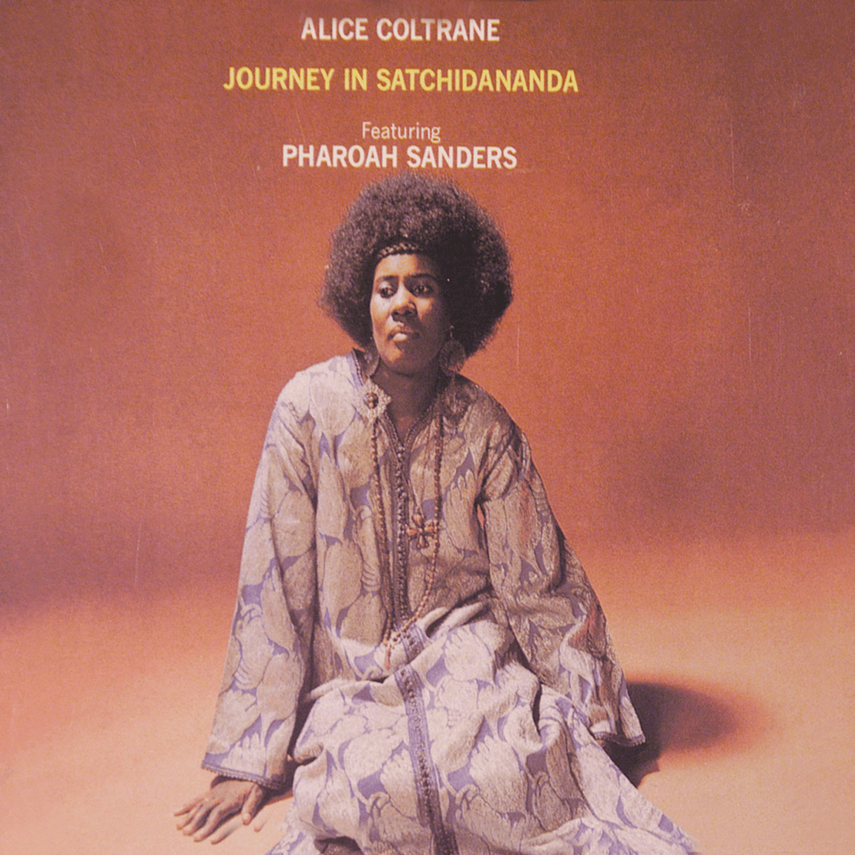
Album cover courtesy of Impulse! Records
Alice Coltrane, like her husband John Coltrane, was a seminal figure in spiritual jazz. She started off as a classical pianist and a church organist who had also played percussion in her high school band. She and her first husband moved to Paris to play at the local jazz clubs, but after her marriage fell apart she moved back to Detroit to rejoin the jazz scene in the city, and shortly thereafter she met John Coltrane.
The pair fell in love and had children together, with Alice giving up her career as a musician momentarily to raise their family. After John had recorded Ascension, he was taking a more avant garde direction in his music, which led to the pianist in John’s band leaving. He asked Alice to join the group. Apparently, critics did not like that, saying that she was forcing John to become more experimental in his music and saying that she broke up the quartet – a media phenomenon I’d like to call yoko-onofication – but none of it was true:
I didn’t have to inspire John toward the avant-garde … He led the way on his own. The man was a genius, he didn’t need anything from me. That’s why it’s so interesting that critics decided to dislike me. At some point the members of the quartet felt it was time for a change, and they left on their own.
After John’s death from liver cancer, Alice continued on the spiritual journey that they had both been on. She became a student of Swami Satchidananda, who today’s record is named after, and later went on to start her own ashram, becoming a spiritual leader named Swamini Turiyasangitananda. She gave up making music for commercial purposes but continued to record worship music that was distributed within the spiritual community, mainly through her ashram, until 2004 when she made her final commercial album titled Translinear Light after a 26-year absence.
Journey in Satchidananda was released in 1971 as Alice Coltrane’s fourth studio album that mixes spiritual jazz with African and Indian blues, Indian classical music and North African and Middle Eastern influences. Pharoah Sanders, who was the first official recipient of a 10 on this blog, features on the record playing saxophone, along with Cecil McBee and Charlie Haden playing bass and Rashied Ali playing drums. The record is widely regarded as being Alice Coltrane’s best work, as well as a seminal record in spiritual jazz.
I usually tend to think about what I’m going to write while I’m listening to something, but this wasn’t one of those albums where that felt appropriate. It took me some time and a bit of concentration to turn my brain off, but once I actually managed to relax, I feel like I almost got a bit too relaxed. I’m pretty sure I dozed off a few times, then woke up and listened to it still sort of half-asleep, then dozed off again, so I went for round two a few hours later and listened to a few songs from the middle where I thought I might have been at least half-snoozing.
Her son described her music as “A beam of light that goes straight through your chest" and that really does feel apt. It’s like you come to at some stage realising that suddenly the air around your body feels electric. If one was to have some sort of transformative spiritual experiences to music, this record would probably be the one to have them to, or maybe some of her non-commercial recordings with Sanskrit chanting over organs, which frankly sounds right up my street.
I was torn between a 9.5 and a 10 but I did eventually settle on a 9.5/10, but I think I could probably quite easily find a 10 somewhere in her discography. And by the way, the eye mask is a revelation. If I would have known earlier that paying less than £10 (delivery included) for a sack of wheat and lavender could make me enjoy one of my favourite hobbies (listening to music) even more, I would have done this ages ago. I got mine from TexArtbySarah on Etsy, 100/10, would recommend.